Homeschool Schedule – How to Create the Perfect Schedule
Homeschool Schedule –
Coming up with a homeschool schedule is likely one of the most daunting tasks as a new homeschooling parent.
It can be equally as intimidating even if you are a seasoned homeschooling parent who is just looking for a little more structure to your days, especially as your children get older.
Google will bring you all sorts of results, blogs & articles full of charts and suggested amounts of hours school “should be” completed within – but you know what I realized? Once again, there is no “right” way to plan a homeschool schedule, just as with all things parenting related.
Do what works best for you & your family and don’t feel overwhelmed by those charts & suggested schedules.
And that is exactly where the uncertainty can set in – at least that is where it happened for me when we started on this homeschooling adventure years ago.
So, after years of trial and error and LOTS of research and tips from other homeschooling parents, I’ve come up with the best tips to guide you to finding out how to find a schedule that is perfect for YOU!
Remove the pressure
First step, as needed in life these days, (looking at you social media!), is stop comparing!
I mean it – it is soooo easy to fall down that exhausting rabbit hole of comparison when it comes to something as personal as homeschooling.
And that’s just what your homeschool choices and plans should be, personal & customized for your family.
Without comparing.
Sounds so simple, yet I do know from experience it’s hard to do.
Creating a homeschool schedule that you and your children will thrive with, can be so rewarding, if you stop comparing your days to other families you may follow on Instagram.
Being inspired by others you may know in real life, or read about online or on social media, can be wonderful.
But, feeling bad that you may not have a dedicated, beautiful school room or feeling like you’re failing your children when you see elaborate co-ops others are a part of, or parents who share ALL of the amazing ways their kids are learning can quickly rob you of that inspiration.
So, before we delve into this topic any further – give yourself some grace, and remove that darn pressure! You’ve got this!!
First year of homeschool?
Now, if you are just starting out homeschooling your kiddos, my first piece of advice is always make sure you have met all of the legal requirements for homeschooling for your state.
Checking that box is important because then you can focus on all of the fun stuff homeschooling brings!
Creating a homeschool schedule that first year of homeschooling can and will change with each year that follows. Whether you’re working with kindergarten, elementary, or middle school and older aged kids, you will learn what works best & what needs to go, schedule wise, with time.
A great tip for the first year is don’t try to recreate a traditional school schedule at home! I go further into this when I wrote all about another frequently asked homeschool question, how long should homeschool take?
Set a routine not a schedule
Children thrive with routine. We all do! Whether we want to admit it or not! Homeschool is another place this is so true.
Knowing what to expect for you as the teacher, with your homeschool planning, and for your kids with what subjects are completed on what day, will help so much when you plan your schedule.
Something else that has been so helpful to me over the years, is having a “routine” rather than a set schedule. Finding your rhythm is key to this, and will only happen with time within your homeschool.
Finding YOUR routine
If your kids are at their most focused selves early in the day, maybe start your days with the tougher subjects for them, like math or spelling, or whatever it is they may struggle with.
If your kids are the types who need a slower start, a morning basket routine can be a great start to your day.
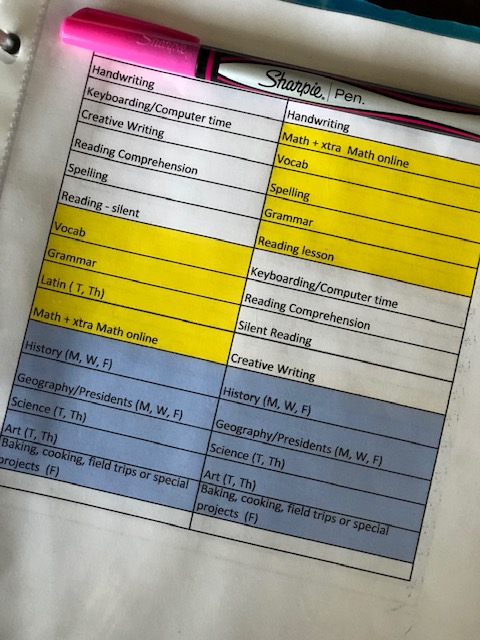
This is also a great time to think about what subjects you will be covering and deciding which ones are to be completed every day and which can be rotated.
Core subjects like math, reading, language arts are typically completed every day.
Other subjects like history & geography, science & art, foreign languages, computer classes like keyboarding or coding etc., can be put on a rotation.
Maybe history & geography on M, W & F and science and art on T & TH. Whatever you choose will work best if it’s working for you – sounds so silly, but it’s true! Not dreading what you have to do simply makes tasks easier.
Planning & flexibility
One thing I am always so thankful for when it comes to homeschooling is the flexibility that it brings to my family’s life.
Nothing has to be set in stone. Unless of course you work and homeschool and have to have a set schedule. For the most part though the option to change things up as needed is really rewarding.
When it comes to homeschool planning, keeping your schedule flexible will be so helpful for the days where something comes up. There are always going to be “those” days. Knowing you have some wiggle room with your schedule will help you from feeling totally overwhelmed.
I have a whole article I wrote on how to plan your homeschool year. With the focus being on learning how to have a general plan and routine in mind. Rather than a set in stone, detailed day to day plan.
Knowing that you would like to have a certain amount of lessons to complete by a certain date is key, rather than setting a strict schedule of specific lessons for specific dates.
Multiple ages
When you are homeschooling more than one kiddo having some schedule or routine in place is especially helpful.
Using block scheduling is one way to help with this. Block scheduling is simply allowing certain chunks or blocks of time for you to work on each subject or to work with each child individually.
So, maybe it’s easiest on you to tackle all of the language arts subjects for all kids at one time. Having a designated block of time for this may work best for you.
Or, on the other hand, if you want to work with each child on their “core” subjects individually, block scheduling works very well for this too.
Blocking out time to work with you on say, math, versus independent time, for say, keyboarding, on a schedule is great at teaching children to be accountable for their time. Teaching time management through what should be accomplished within that time block is a great skill to start at an early age.
Read this post for more information on teaching multiple ages and keeping it all together!
Top tips for creating a homeschool schedule
1. Don’t stress yourself out by comparing your homeschool experience to other homeschooling families!
2. While you may love all the school supplies (I sure do!) and things that go along with school, don’t try to recreate school at home! Schedule wise it just doesn’t make sense.
3. Come up with a personalized routine that helps your day flow! Don’t stick to a schedule if you’re all miserable just to check the boxes. Change it up! Homeschool can be so much fun for you and your kids. The key is to relax and find the rhythm that works best for your family.
4. Set up some sort of scheduling that works well for you if you have multiple kids you are homeschooling. Block scheduling can really help with this! Also, blocks can be shifted around, helping with flexibility when needed.
5. And, speaking of flexibility – embrace that amazing perk of homeschool life!!
I hope all of these tips and ideas help you whether you are a new homeschool parent or just looking to get a little more order in your days. Finding a schedule or routine that works for your family is so rewarding. It allows you to take a step back and see all the amazing ways homeschool adds to your family life!